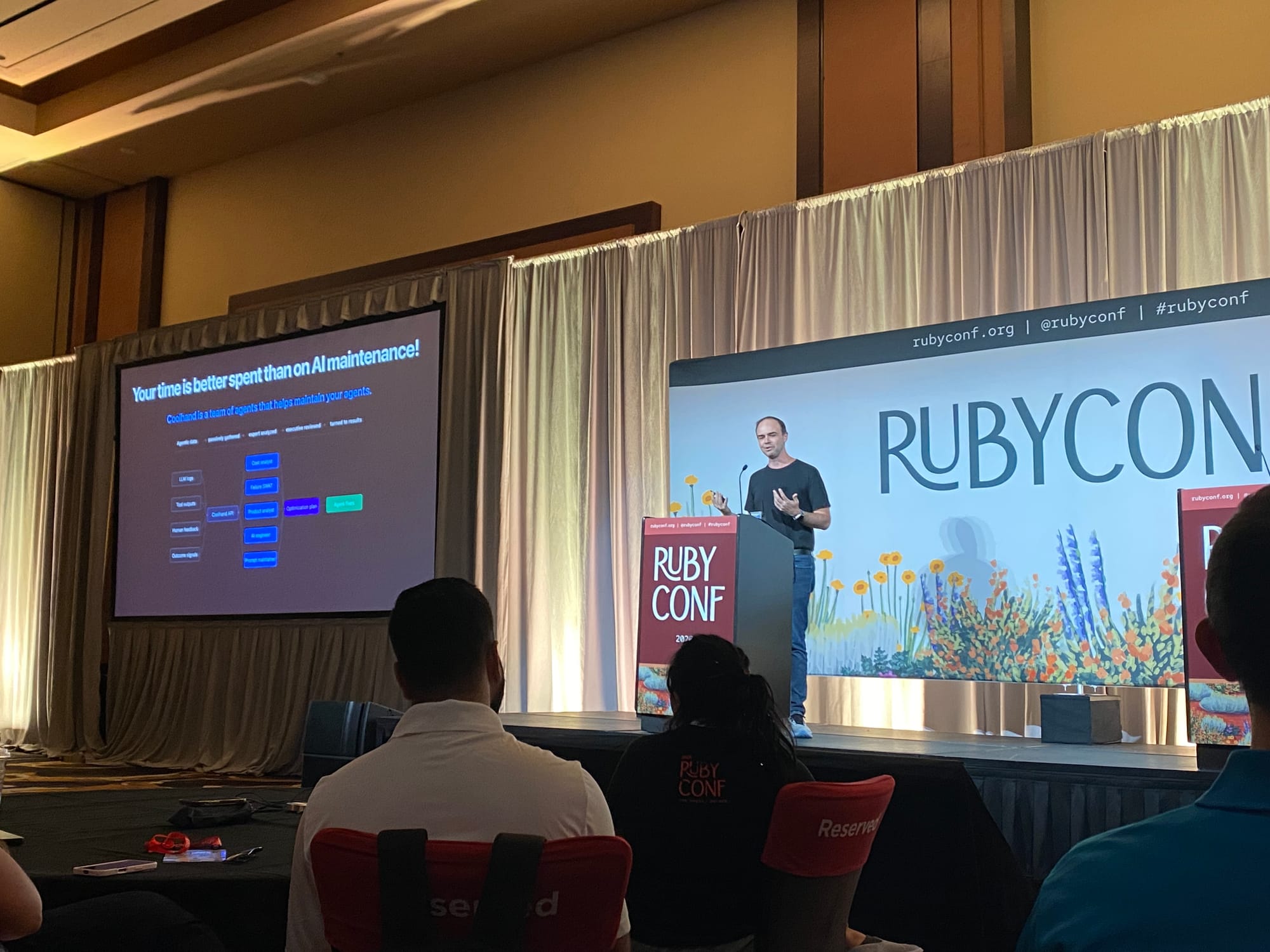
This is part of an ongoing series of Ruby Runway Spotlights, celebrating the founders who took part in the inaugural Ruby Runway Showcase at RubyConf 2026. Each spotlight is a chance to hear directly from the builders turning Ruby into real, live businesses, and to cheer them on as they keep going.
Tell us your name, your startup, and what it does in one or two sentences.
I'm Michael Carroll, founder of Coolhand Labs. Coolhand Labs is a COO for your AI agents. Whether they run on your computer or in prod, we use log traces and human feedback to keep an eye on them and optimize for efficiency and quality, often cutting costs over 50% in the process.
What problem are you solving, and who feels it most? How does your Ruby-powered solution change things for them?
After RubiconMD was acquired in 2021, I decided to take a beat and build something for myself. I drew on my youthful passion for Dungeons & Dragons to create an AI-driven multiplayer storytelling game called innori. A huge chunk of my time building innori was spent adjusting the AI based on human feedback, and I thought "I'll just build a simple AI service to take this work off my plate."
Unsurprising twist: it wasn't simple. I also found out that a lot of great engineers I've worked with in the past were struggling with the same problem. They were using AI observability options like LangSmith and Langfuse, but finding that the observability paradigm wasn't getting them far.
The problem with dashboards, besides the fact that nobody ever looks at them, is that you need a deep knowledge of the system they are observing to obtain meaningful results. AI tools are changing so fast that almost nobody can do that!
So I started spending more and more time on Coolhand and opened it up to others, and realized that "an AI service to help engineers constantly improve AI services" was something I really wanted to spend my time on. I asked a few early users to pay to use it, and they pretty quickly agreed, so Coolhand Labs was profitable almost from the moment we launched.
One thing I didn't expect early on was the interest in our Ruby gem. The AI observability solutions have basically abandoned direct support for all platforms that aren't Python or NodeJS-based. I had built a Coolhand Ruby gem (please give it a GitHub star!) to collect LLM traces for my own internal use, and people kept reaching out to me about it. They wanted to use it to collect traces for their own tools. Some even became early Coolhand Labs customers.
Building for the Ruby community always compounds in value, and I'm happy to keep that mission at the core of the company! To my knowledge we are still the only AI dev tools company that maintains a Ruby gem.
Ruby has a reputation for developer happiness and elegant code. How has building with Ruby shaped the way you think about your product?
One thing people seem to have forgotten is that Ruby (and Rails) were the original "vibe coding" platforms, and that is a big part of what makes building with it so much fun: Ruby has its own comic strips, core maintainers who wear wigs, and superstar personalities who drive race cars.
At Ruby meetups ten years ago, you'd meet a person who knew nothing about coding, give them advice on turning the Twitter clone they'd forked from a tutorial into their "uber for leftovers" app idea (true pitch I heard), and then next time you saw them it was years later at a meetup where they were giving deep technical perspectives on a gem they'd built. People would start with a Rails app from a generator and get sucked into engineering. I truly believe many "vibe coders" building apps today will end up doing the same, and hope the Ruby community will continue to embrace all such newcomers.
That Ruby philosophy of ease-of-use and inclusion really influences how we build at Coolhand Labs. Sure, Coolhand is an agent that "does the AI dredge work for you," but it also is an agent that has an evolving opinion on how to build AI agents in a way that's clean, fun to follow, and aims to include you in the journey: "structured outputs are better here because of X" or "try giving your agents this no-op tool, and you can trick them into telling you when they are failing." This all draws inspiration from the Ruby ecosystem.
What would you say to another Ruby developer sitting on a startup idea right now, wondering if they should go for it?
One thing I love about Ruby is that the goal is to enjoy the journey (building the thing) as much as the destination. I'd apply the same paradigm to starting a startup. If you know you would enjoy the full experience (searching for your first users, experimenting with monetization pathways, questioning everything you are doing every single day) then definitely do it. That way, even if you wind up as a garbage collector again at the end, you will be satisfied that you had a great run of it.
What's your origin story? Tell us who you are, what your startup does, and the moment you knew Ruby was the right foundation to build it on.
Elephant in the room: I'm not the Michael Carroll who won 9 million pounds in the UK lottery and spent it all on banger racing and bling, before returning to being a garbage collector. Kind of hard to top that guy: gotta give him credit for pursuing what he loves.
No: I'm the Michael Carroll who studied Medieval Chinese Buddhist Philosophy at the University of Hong Kong, realized there was no job market for it (common mistake), and pivoted into engineering and startups. If you think coding and B2B sales are difficult, try inferring the double-entendres and verbal puns in an extinct Chinese dialect.
My origin myth is that I learned C++ in high school, found it tedious, and then only much later found out that "tedious" was just a language feature of C++. Discovering Ruby gave me back that excitement I got from my very first "Hello World," but the difference was that I got that joy every time I wrote with Ruby. When I built RubiconMD, a health tech startup that connected doctors to improve patient care, I knew that I wanted to hire people who found the same passion for writing code in Ruby as I did. We ended up putting together a really amazing, international team all joined with that shared love of Ruby.
So Ruby has always been my default choice. I've programmed in a lot of other languages, JavaScript (and CoffeeScript, remember CoffeeScript?!), Python, Elixir, Java, ObjectiveC, but none of them gave me the same anticipation to open the IDE that Ruby does.
Find Coolhand Labs:
Website: coolhandlabs.com GitHub: Coolhand-Labs X: @coolhand_labs LinkedIn: Coolhand Labs
Coolhand Labs was one of the founding companies featured in the Ruby Runway Showcase at RubyConf 2026. Stay tuned for more spotlights from this inaugural cohort of Ruby-built startups.