This is part of an ongoing series of Ruby Runway Spotlights, celebrating the founders who took part in the inaugural Ruby Runway Showcase at RubyConf 2026. Each spotlight is a chance to hear directly from the builders turning Ruby into real, live businesses, and to cheer them on as they keep going.
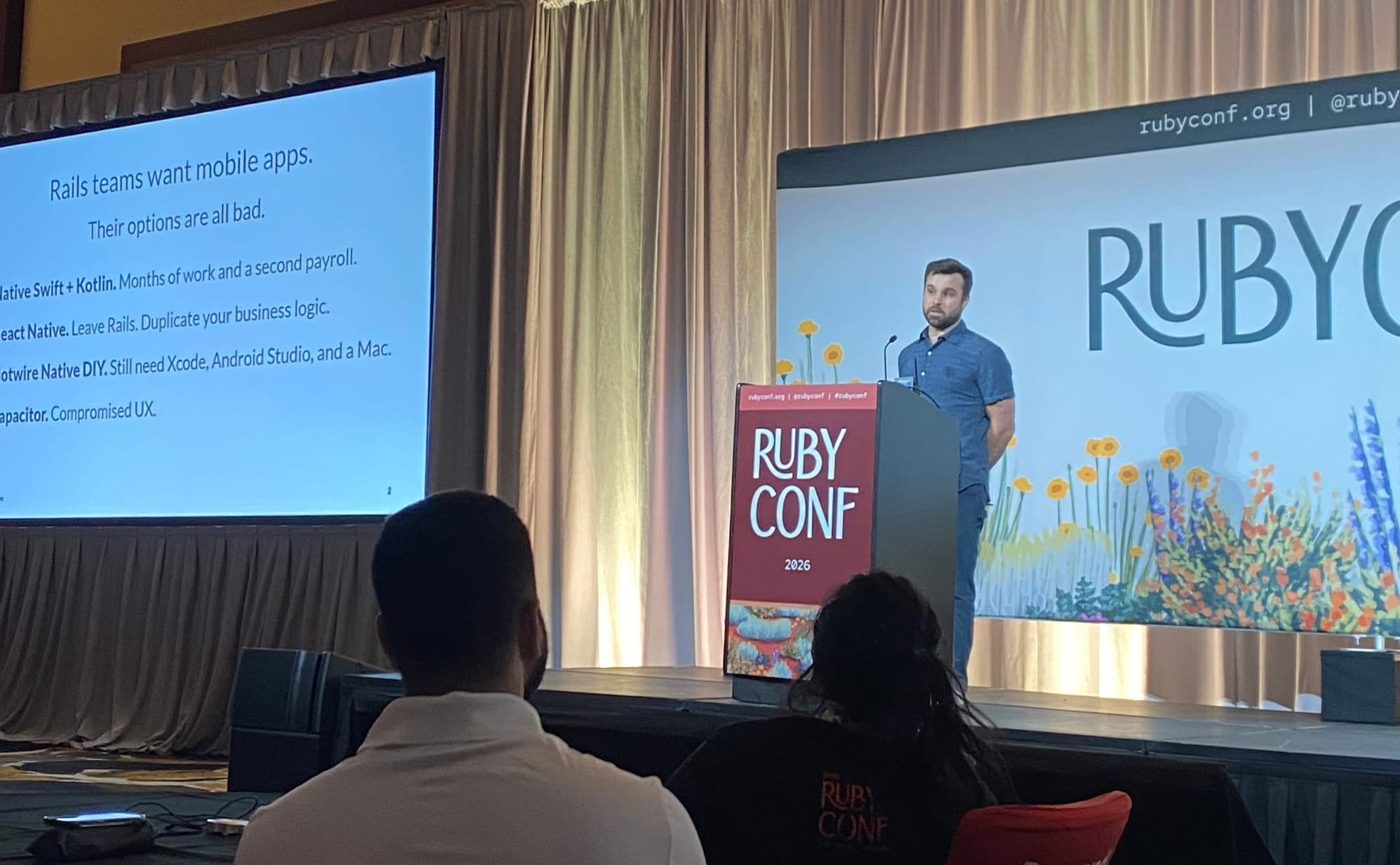
Tell us your name, your startup, and what it does in one or two sentences.
I'm Joe Masilotti, and I help Rails developers deploy to the mobile app stores. Ruby Native builds real iOS and Android apps from the HTML and ERB you already have, without writing Swift or Kotlin.
What problem are you solving, and who feels it most? How does your Ruby-powered solution change things for them?
Your customers want an app. The usual way to give them one is a separate native build in Swift and Kotlin, often a mobile developer or two, and another codebase to keep in sync with your Rails app. Ruby Native skips all of that. You write the same HTML and ERB you always have, and it renders as real native components: tab bars, navigation, forms, dropdowns, you name it. One command ships to the App Store and Google Play, still powered by the Ruby you write all day. It helps solo founders and small teams the most, the folks who can't justify a mobile hire but are quietly losing users who expect an app in the stores.
Ruby has a reputation for developer happiness and elegant code. How has building with Ruby shaped the way you think about your product?
Ruby taught me to optimize for developer experience above almost everything else. Matz designed the language to make programmers happy, and you feel it in the sensible defaults, the escape hatches, and ceremony that isn't there. Ruby Native is built the same way: the common path is a single command and a few view helpers, not a ton of config files. You scan a QR code and your app is running on your phone. It follows the expectation Ruby sets that one person can ship something real, backed by a community generous enough that good ideas spread fast.
What would you say to another Ruby developer sitting on a startup idea right now, wondering if they should go for it?
Ship the smallest version that solves one real problem, talk to the people using it, and charge real money as soon as you can. Nothing proves you have traction like a customer reaching for their credit card. I've done this many times, and charging early is how I've killed weak ideas fast. When nobody wants to pay, you learn the idea wasn't as good as you hoped, and you can move on in a week, instead of wasting years building the wrong thing.
What's your origin story? Tell us who you are, what your startup does, and the moment you knew Ruby was the right foundation to build it on.
Over the past decade building native apps for iOS and Android, I wrote a book on Hotwire Native and shipped more than 25 mobile apps on top of Rails. Along the way I kept doing the same native plumbing for every client: the same Xcode and Android Studio projects, the same web view wrapper, the same deploy dance. Ruby Native came out of automating all of it. My goal is to get Rails developers into the App Store and Google Play while they keep doing what they love, writing Ruby and building web-powered businesses. Rails is where these apps already live, so instead of wrangling Xcode and Android Studio yourself, you get a gem, a CLI, and a cloud build pipeline that fit the way you already work.
Find Ruby Native:
Website: rubynative.com GitHub: ruby-native X: @joemasilotti
Ruby Native was one of the founding companies featured in the Ruby Runway Showcase at RubyConf 2026. Stay tuned for more spotlights from this inaugural cohort of Ruby-built startups.