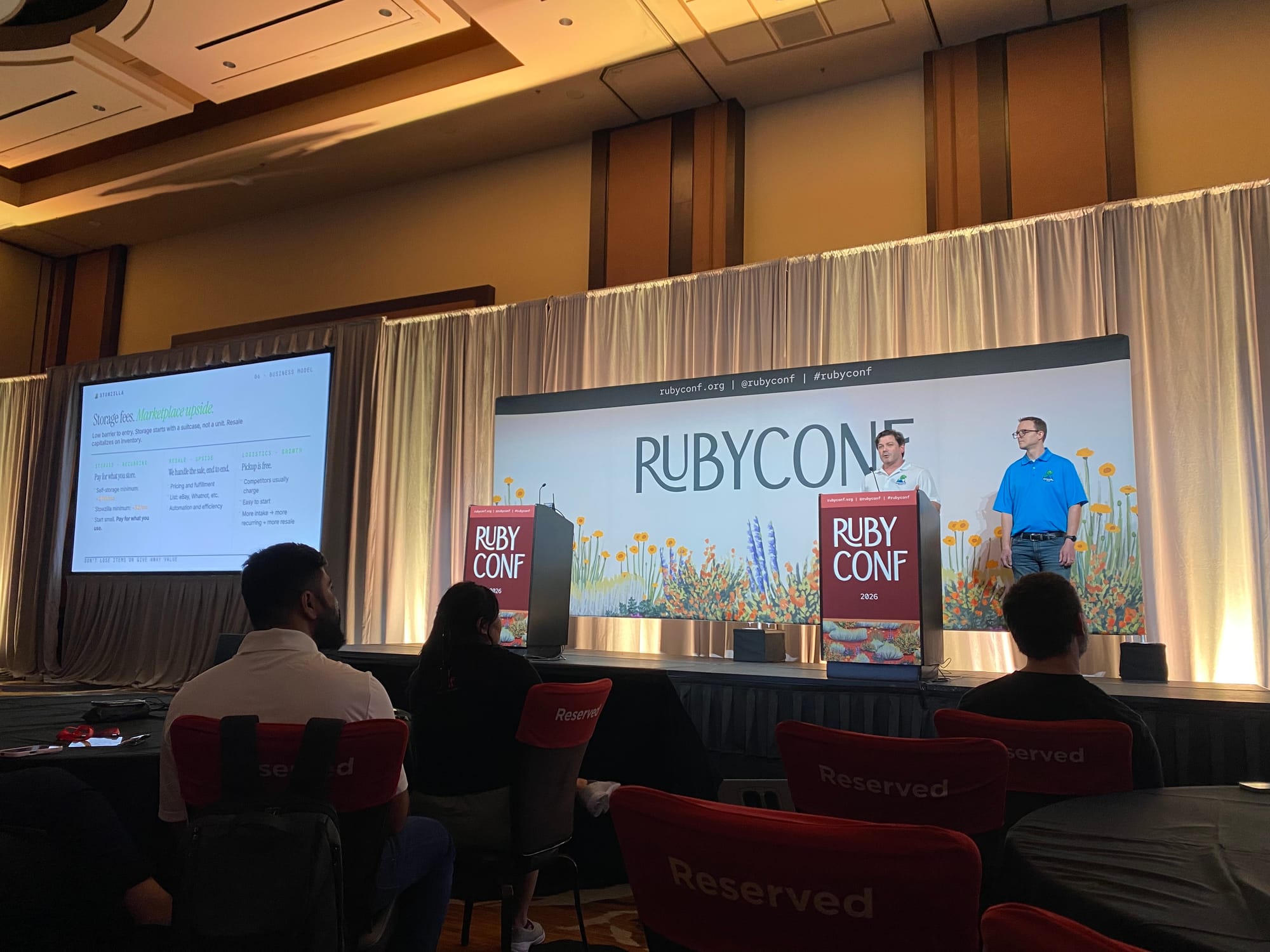
This is part of an ongoing series of Ruby Runway Spotlights, celebrating the founders who took part in the inaugural Ruby Runway Showcase at RubyConf 2026. Each spotlight is a chance to hear directly from the builders turning Ruby into real, live businesses, and to cheer them on as they keep going.
Tell us your name, your startup, and what it does in one or two sentences.
Stowzilla is your personal warehouse service. Know what you have, and get value from the things you no longer need.
What problem are you solving, and who feels it most? How does your Ruby-powered solution change things for them?
We're solving the problem of getting valuable stuff to people who can use it, and giving space back to the people who don't need it anymore. People can face decision paralysis when they have too much stuff. They know it has value, but they don't know what to do with it.
We remove it from their physical space and give them a searchable digital inventory. Decisions become clicks. We handle the storage, inventory, and selling, and return anything they want back.
We used Ruby to build Brainiac, our agent orchestration platform, which keeps multiple projects in context so we can develop effectively in a service-oriented environment. We've also built several tools that make Ruby work better on AWS.
Conveyor Belt is a Terraform provider that uses familiar conventions to quickly build reliable, secure web services. Belt is a serverless application development framework. S3arch is a low-cost alternative to full-text search services like OpenSearch.
Ruby has a reputation for developer happiness and elegant code. How has building with Ruby shaped the way you think about your product?
We believe Ruby's focus on making programmers happy is one of the main reasons AI agents are so effective with it. The community has contributed decades of thought, conventions, and infrastructure, so the agents are standing on the shoulders of giants.
Convention over configuration. YAGNI. DRY. These ideas are deeply embedded in the training data agents learn their Ruby knowledge from. They're basically part of their artificial DNA.
What would you say to another Ruby developer sitting on a startup idea right now, wondering if they should go for it?
There's never been a better time to build. The time from recognizing a problem to developing a workable solution has never been shorter. It's not easy, but the tools exist to get the job done, and the Ruby community will support you the whole way.
What's your origin story? Tell us who you are, what your startup does, and the moment you knew Ruby was the right foundation to build it on.
Adam Dalton and Andy Davis met in 2009 at NASA's Kennedy Space Center while building ground-support software for launch services using Ruby. Adam left in 2012 to work in AI and cloud computing, while Andy stayed to see the project through as it eventually became Artemis, the first crewed lunar mission in more than 50 years.
They always wanted to work together again. In 2021, Adam and Larissa Dalton faced an unexpected and stressful move and couldn't believe there weren't better ways to deal with all their stuff. The seed for Stowzilla was planted: there had to be a better way.
The stars aligned in 2026, and Andy and Adam started programming together again, in Ruby, of course. Larissa finds efficient storage space, while Stowzilla helps valuable items find new homes where they can be useful.
Find Stowzilla:
Website: stowzilla.com GitHub: stowzilla X: @stowzilla TikTok: @stowzilla
Stowzilla was one of the founding companies featured in the Ruby Runway Showcase at RubyConf 2026. Stay tuned for more spotlights from this inaugural cohort of Ruby-built startups.